
April 2026
UW–Madison’s Economic Impact
The University of Wisconsin–Madison is a major economic driver, generating economic activity through our research, healthcare, industry partnerships, student and visitor activity, and innovative startup companies that extends across the state.
About this report
The report below was produced in 2026 by Tripp Umbach, a national leader in economic impact analysis, and it measures UW–Madison’s contributions to Wisconsin’s economy.
Combined impacts
Together, UW–Madison, its affiliated organizations, and its spin-off companies generate significant economic impact across Wisconsin, supporting jobs, contributing tax revenue, and delivering strong returns on investment.
Total impact on the Wisconsin economy
$38.9 billion
Generated in economic impact
UW–Madison contributes to Wisconsin’s economy in many ways, through our research activity, employment, healthcare services, student spending, and partnerships with businesses and communities across the state. Together, these activities generate billions in economic impact each year.
Jobs supported across the state
287,232
Jobs supported
University operations, education, research, health care, and related spending support jobs in communities throughout Wisconsin. These roles include positions on campus as well as jobs across industries that benefit from university-related activity.
Tax revenue for Wisconsin
$1.94B
In taxes generated
Economic activity connected to the university generates tax revenue for Wisconsin through employment, business activity, and spending tied to university operations, research, and healthcare.

Return on investment
$21.66 to $1
Returned
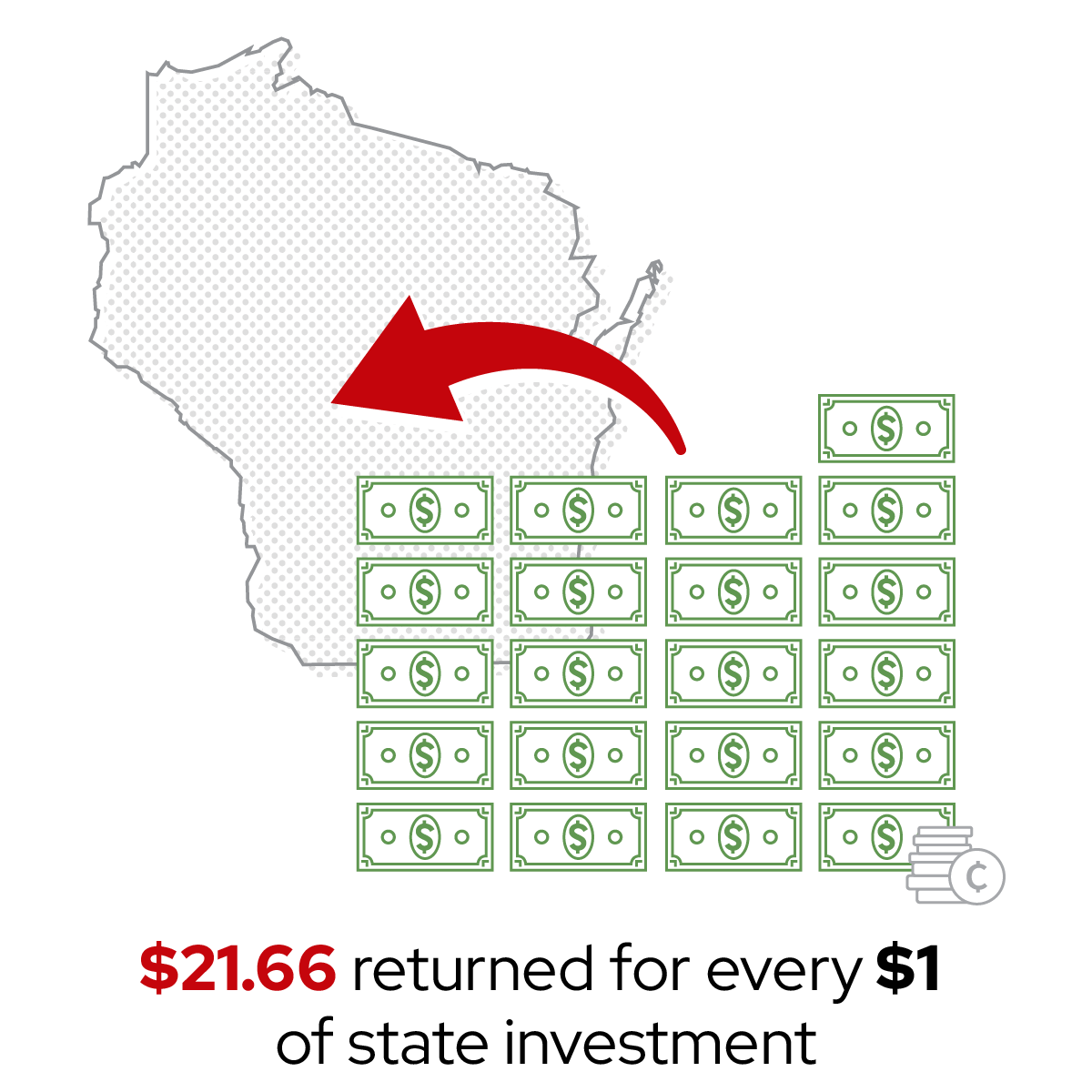
For every $1 of taxpayer investment in UW–Madison, the university generates $21.66 in benefit back to the state. Public investment in the university supports research, workforce development, healthcare, and innovation, while producing a significant return for the state’s economy.
This kind of impact is never accidental. It reflects an intentional, longstanding partnership between the state’s commitment to a strong public university, federal investment in basic research that lays the foundation for future breakthroughs, and UW–Madison’s mission to ensure those discoveries benefit communities throughout the state, nation, and world.

Key contributors to economic impact
UW–Madison’s economic impact is driven by several major areas of activity, including its research enterprise, healthcare partnerships, athletics programs, and companies formed through university innovation.

$3.0B
Research
Statewide, UW–Madison’s research enterprise generates $3.0 billion in economic impact and supports 7,872 jobs through sponsored research activity, industry partnerships, and related spending.

$12.9B
UW Health
UW Health generates $12.9 billion in economic impact and supports 92,906 jobs, reflecting its role as a major healthcare provider, employer, and driver of economic activity in Wisconsin.

$12.4B
Spin-off companies
Startup companies based on work done at UW–Madison generate $12.4 billion in economic impact and support 88,571 jobs across Wisconsin. These companies translate university discoveries into products, technologies, and businesses that contribute to growth throughout the state.

$977.2M
UW Athletics
UW Athletics generates $977.2 million in economic impact and supports 7,150 jobs through events, tourism, media activity, and related economic spending.
Alumni and community impact
UW–Madison’s impact continues long after graduation. More than 196,000 alumni live in Wisconsin, contributing to the state’s workforce, businesses, and communities. Separate from the university’s overall economic contribution, individual faculty, staff, students, and alumni support communities across the state through their charitable giving and volunteer service.

$23.0B
Alumni impact
UW–Madison’s 185,487 working alumni in Wisconsin contribute $23.0 billion annually to the state’s economy through their employment, earnings, and business activity.

$156.0M
Charitable giving and volunteerism
UW–Madison students, faculty, and staff contribute $156.0 million in charitable giving and volunteer service, which includes $38.9 million in donations and volunteer time valued at $117.1 million.
People and stories behind the numbers
UW–Madison’s economic impact isn’t just about statistics. It represents real outcomes for real Wisconsinites in communities all across the state.

rural health care
UW–Madison medical training program improves health care for rural communities
By creating a pathway for future doctors to provide excellent care to small communities, the Wisconsin Academy for Rural Medicine supports health care in all corners of our state.

Agriculture
UW–Madison researchers and Wisconsin farmers work together to produce healthy potato harvests
For decades, farmers across the state have worked closely with vegetable researchers at the University of Wisconsin–Madison to ensure a healthy harvest, from the initial seed supply to disease prevention and management.

Service to the State
Measuring UW–Madison’s impact: Wisconsin Idea Database reports benefits for all 72 counties
The latest data compiled from around campus show how UW–Madison provides educational opportunities, builds the workforce, and boosts the economy all around the state.

Industry Partnerships
Local partnerships power real solutions
All over the state, UW–Madison is partnering with local businesses to improve people’s lives.
UW–Madison doesn’t just do research. It generates new companies that fuel the state’s innovation economy. The discoveries made on campus feed a pipeline of startups that create jobs, import capital, build new industries and move Wisconsin’s core sectors forward.
The economic impact of UW–Madison is felt in every corner of our state. The university is an incredible partner with our counties and our communities. For Wisconsin to thrive, grow, and succeed both today and in the future, we must work diligently across all areas of academics, outreach, and research.
Reports
The findings summarized on this page are drawn from the full economic impact analysis conducted by Tripp Umbach. For additional details on the methodology and findings, you can explore the complete report and supporting materials below.
Full report
A deeper dive into the full 59-page economic impact study.
One-pager
An at-a-glance view of the economic impact study.
Budget in brief
A summary of how UW–Madison is funded and how dollars are used.
About the data
UW–Madison contracted with national consultant Tripp Umbach to measure its economic and community contributions to Wisconsin. Tripp Umbach employed a rigorous, conservative methodology grounded in the industry standard IMPLAN model and enhanced by proprietary techniques refined over the firm’s nearly 40 years of experience.
UW–Madison’s total economic impact includes its direct and indirect effects on the Wisconsin economy. Direct impact includes UW–Madison’s institutional, employee, and visitor spending on the institution itself. Indirect impact, also known as the multiplier effect, is the additional economic impact created as a result of the institution’s direct impact. It includes additional spending by vendors, suppliers, and households within the state economy. Companies that supply goods and services to an institution increase its purchasing power through a multiplier effect, which results in a greater impact on the economy.
The combined impacts reported above include those of UW–Madison, affiliated organizations, and spin-off companies. Read the complete report for more details on each component part.
UW–Madison drives economic activity that reaches businesses and communities across Wisconsin.
UW and its affiliated organizations and spin-off companies generate $38.9 billion in annual economic impact.
This total includes university operations, spending by students and visitors, and the broader economic activity created when employees, vendors, and businesses spend money throughout the state.
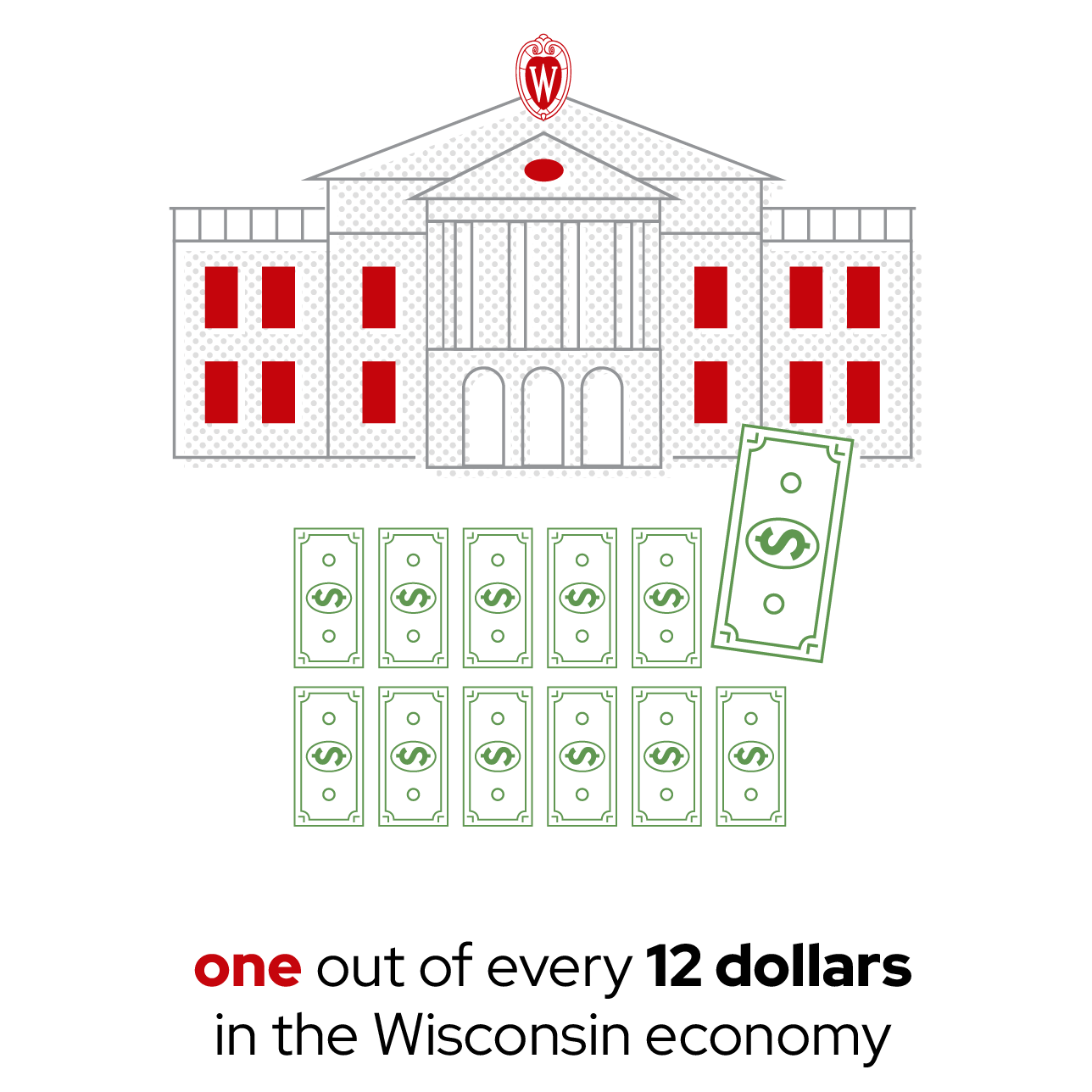
Together, these activities represent $1 out of every $12 generated in Wisconsin’s economy.
Public investment in UW–Madison produces measurable returns for Wisconsin.
For every $1 invested in the university, the state receives an estimated $21.66 in economic return through job creation, business activity, research innovation, healthcare services, and companies founded on university discoveries.
These returns reflect the university’s role in recruiting and developing talent, advancing new technologies, supporting industry partnerships, and strengthening the state’s economy.
UW–Madison supports employment across Wisconsin through research, healthcare partnerships, startup companies, and the broader activity connected to the university.
In total, UW–Madison and its affiliated organizations and spin-off companies support 287,232 jobs statewide.
These include jobs within the university and healthcare system, positions created by startup companies, and employment supported through business activity connected to the university community.
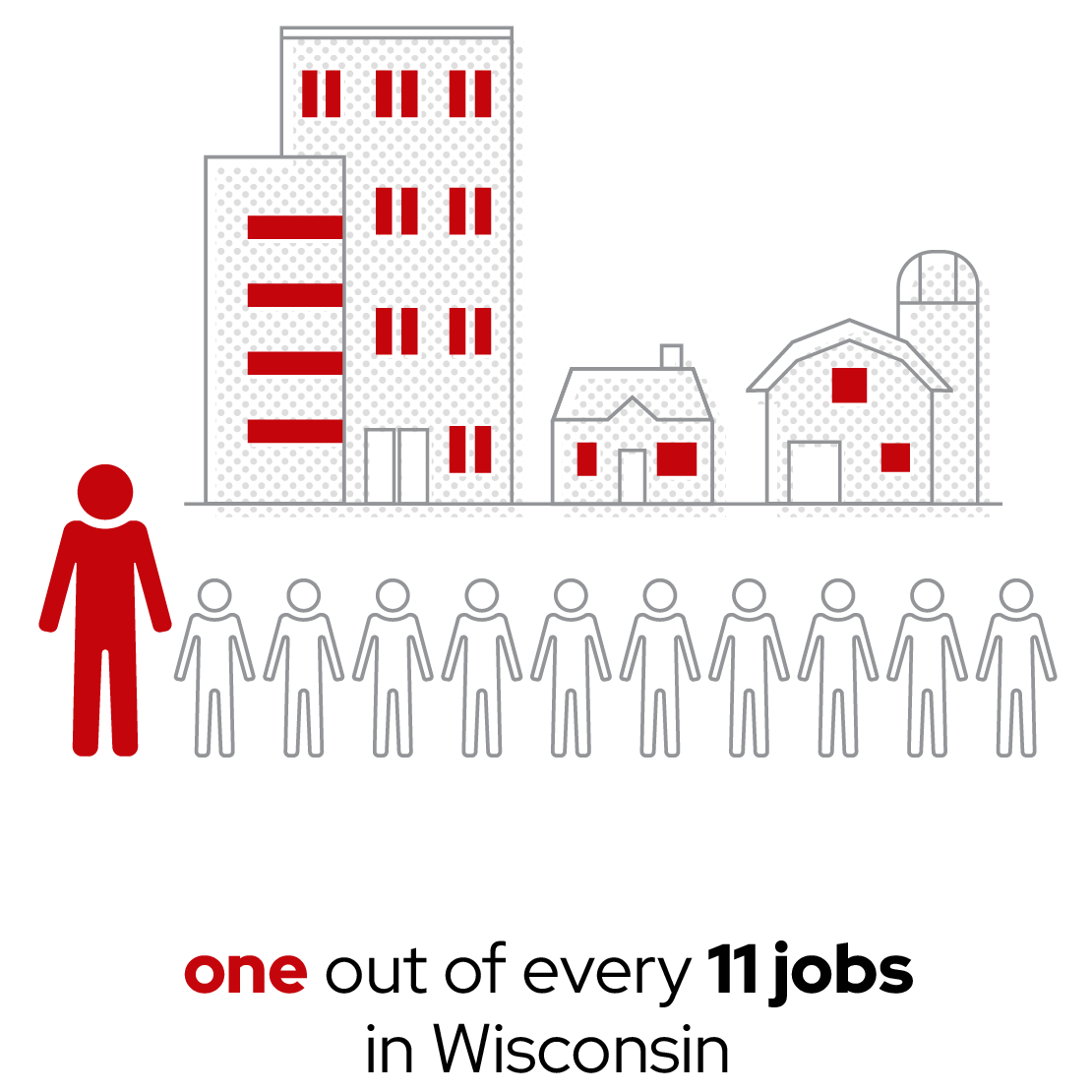
Altogether, UW–Madison contributes to 1 in every 11 jobs in Wisconsin.
Economic activity connected to UW–Madison helps generate tax revenue that supports public services across Wisconsin.
This activity produces $1.94 billion in state and local taxes each year.
These revenues are driven by employment, business growth, healthcare services, research partnerships, and consumer spending connected to the university.
Overall, activity connected to UW–Madison accounts for $1 for every $12.70 collected in state and local taxes in Wisconsin.
UW–Madison research drives innovation, saves lives, creates jobs, supports small businesses, and fuels the industries that make Wisconsin—and the U.S.—stronger.
The university’s research enterprise generates $3.0 billion in economic impact in the state and supports 7,872 Wisconsin jobs through sponsored research activity, industry partnerships, and related spending. UW–Madison’s innovative research, outstanding scholarship, and next-generation thought leaders have long-term benefits for Wisconsin, the nation, and the world.
Find out more about UW–Madison’s research impact.
UW–Madison benefits all of Wisconsin’s 72 counties and local communities all around the state. Find out more about UW–Madison’s impact at the county level through the Wisconsin Idea Database.
The relationship between UW–Madison and the private sector has long been a cornerstone of Wisconsin’s economy, spanning more than a century of collaboration. From early breakthroughs like the Babcock butterfat test to today’s work in fusion energy and quantum computing, the university bridges academic discovery and real-world application, serving as a catalyst for innovation locally and globally.
Industry partners gain access to a strong pipeline of workforce-ready talent. Beyond recruiting graduates in high-demand fields, employers connect with students through hands-on experiences like capstone projects and internships. UW–Madison’s wide array of professional development offerings helps existing employees build their skills and stay competitive.
The university also connects industry to world-class research and intellectual property. Through licensing, sponsored research, and collaborative partnerships, companies can tap into UW–Madison’s research enterprise to solve complex challenges.
This ecosystem ensures campus innovations move beyond the lab into real-world impact and economic growth. For more information, contact the Office of Business Engagement, which helps companies navigate the university and build high-impact partnerships.
UW–Madison has a long legacy of innovation and entrepreneurship. Since 1990, more than 400 spin-off companies across Wisconsin started at UW–Madison. These companies currently generate an annual economic impact of $12.4 billion and support 88,571 jobs.
Twenty eight of those companies, founded by 33 UW–Madison alumni between 1997 and 2021, each individually achieved a valuation of over $1 billion. Find out more from the Wisconsin Entrepreneurship Hub.
This page highlights selected findings from UW–Madison’s economic impact analysis. The full report also includes regional impacts across Wisconsin’s nine economic development regions, along with additional breakouts for agriculture, Extension, UW–Madison’s health sciences enterprise, and other affiliated organizations and mission areas. Read the full report for more detail.
Social media toolkit
Full-resolution images and suggested social media copy are available in Box to help promote this report.